
Writing Tip: Plotter or Pantser?

Do you plot your stories, or fly by the seat of your pants?

Plot means the story line.  When people talk about plotting, they mostly mean how to set up the situation, where to put the turning points, and what the characters will be doing in the end.  What happens.

Some fiction writers write organically, not knowing where the story they are writing is going.  These writers say it would be boring to know what’s going to happen next and they lose their enthusiasm to tell the story because they know the outcome already.  They prefer throwing themselves over the edge and into the void.  This method can be very anxiety-producing.  It means you need a lot of faith in your process.

Other writers plan the story before they begin.  In detective fiction the story definitely needs to be worked out beforehand so information can be drip-fed to the reader.

In the past, when creating my short stories, I have worked organically and not known where my stories were headed as I wrote them.  The shorter the piece of fiction, the less need for plot.  You can write an interesting story in which not very much happens.  A woman fights with her neighbour, a man quits his job, or an unhappy family goes out for a pizza.  Simple structures work better than something too complicated when the story is short.

Now that I’m working on a new novel, I feel the need to plot.

“A plot can, like a journey, begin with a single step.   A woman making up her mind to recover her father’s oil paintings may be enough to start.  The journey begins there, as it did for Raskolnikov in Crime and Punishment when he decided to commit his crime,”  Jerome Stern Making Shapely Fiction

The plot grows and develops out of what helps and what hinders the characters’ progress toward their goals.

The Writers’ Workshop   http://www.writersworkshop.co.uk/plot2.html  ask:

  • But how do you know if your draft plot has the right amount of weight to carry an entire novel?
  • What kind of structures work?
  • Is there a quick way to design your own plot template?
  • And how do you handle a book with multiple points of view?

“A good plot has a clear motivation.  It has a clear structure.  It has an outcome.  It has subplots.  A good plot looks something like the plot structure template below,” The Writers’ Workshop.

MotivationLizzie Bennett wants to marry for love
Plot structureShe meets Darcy & Wickham. She dislikes Darcy, and starts to fall for Wickham. Wickham turns out to be a bad guy; Darcy turns out to be a good guy. She now loves Darcy.
OutcomeShe marries Darcy
Subplot 1Jane Bennett (Lizzie’s nice sister) loves Bingley. Bingley vanishes. He reappears. They get hitched.
Subplot 2Lydia Bennett (Lizzie’s idiot sister) elopes with Wickham. She’s recovered.
Subplot 3An idiot, Mr Collins, proposes marriage to Lizzie. She says no. Her friend, Charlotte, says yes.

Of course, there are a lot of things that the above plot template doesn’t tell you.  It doesn’t say where the novel is set, it doesn’t tell you anything about plot mechanics – it doesn’t say why Lizzie dislikes Mr Darcy, or how Lydia is recovered from her elopement.  It doesn’t have anything to say about character.

The Writers’ Workshop strongly advises us to build a template much like the one above before starting to write.  “If you’ve already started your MS then, for heaven’s sake, get to that template right away.”

So I’ve decided to put myself out of my misery and create a Plot Template for my new novel.  I already had my characters in place and knew what each character wanted.  But now I’m forced into planning an ending, which isn’t a bad thing.  Some writers don’t find the real beginning to their stories until they’ve written the ending.

So that’s all we need:  a beginning, a middle and an end.  Aristotle defined it like this:  a beginning is what requires nothing to precede it, an end is what requires nothing to follow it, and a middle needs something both before and after it.

Easy peasy.  Not.

What about you?  Do you plot or write organically?  What works and what sends you straight to the Writers Block Corner?

Header image:  Photo by Yogendra Singh on Pexels.com

My Poem, ‘White Ibis’

Have a read of my poem ‘White Ibis’, first published in Quadrant Magazine. ‘White Ibis’ is one of the poems in my debut poetry collection ‘The Cellist, A Bellydancer & Other Distractions‘ (Ginninderra Press).

I hope you enjoy it.

White Ibis:

We wish that nature could stay put

in their home, far away …

not urban tip turkeys, bin chickens –

not like us,

scrounging for a living in cities,

but stay where they thrive,

feeding in swamps, lagoons,

floodplains & grasslands

their black downward-curved bills

digging for crayfish and mussels.

The farmers’ friend,

featherless black heads

flocking in V-shaped flight

to locust-afflicted areas,

gorging on ravaging hordes of insects.

Unlike us, they can eliminate

plagues with ease.

There are nights when we fall asleep

dreaming of ibises

flying back home.

Copyright 2024 Libby Sommer

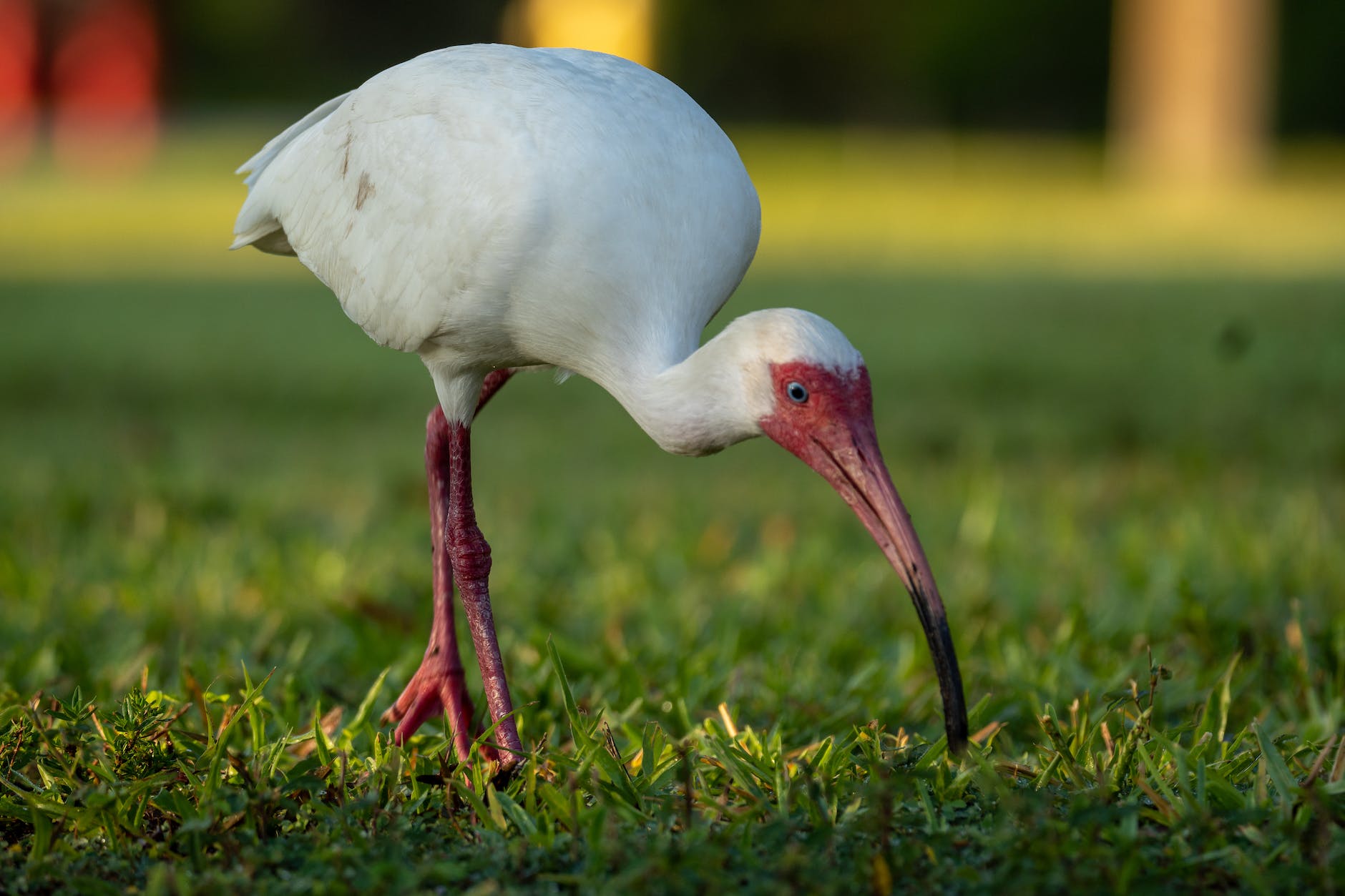
Photo by Luis Arango on Pexels.com

Australian Poetry Book Publishers 2024

Australian Poetry Book Publishers 2024.

Click ‘Australian Poetry Book Publishers’ to read the 2024 list from Poetry Sydney.

‘Useful if you have a ms eagerly awaiting an outlet, but it’s also a guide for the reader. Explore what’s out there in this country as the press listings also have web page addresses. It’s not all bad news!’ Poet, Les Wicks.

Poetry Sydney is an independent literary organisation committed to a presence for poetry in our culture.

My Poem ‘Survival’

Have a read of my poem ‘Survival’ first published in Quadrant Magazine. ‘Survival’ is one of the poems in my debut poetry collection ‘The Cellist, a Bellydancer & Other Distractions‘ (Ginninderra Press).

I hope you enjoy it.

Survival

More gusts of wind

through new high-rises

sharped-edged.

More traffic,

more construction dust

much overshadowing

in grey & black.

Newly-planted in the local streets

the bottlebrush should know why it exists:

nectar feeding of insects,

of butterflies & birds.

East of the city

blue beaches dazzle & swell.

They re-emerge

in a spring break out

giving hope to the lone crimson flower

squeezing through densely-packed leaves.

Copyright 2024 Libby Sommer

Writing Tip: A Novel-in-Stories

The Crystal Ballroom red and black book cover

My second novel, ‘The Crystal Ballroom‘ (Ginninderra Press) is a novel-in-stories.

So what is a novel-in-stories? One famous example  is Elizabeth Strout’s Pullitzer Prize-winning ‘Olive Kitteridge’.

‘A penetrating, vibrant exploration of the human soul, the story of Olive Kitteridge will make you laugh, nod in recognition, wince in pain, and shed a tear or two.’ – Goodreads ‘In a voice more powerful and compassionate than ever before, New York Times bestselling author Elizabeth Strout binds together thirteen rich, luminous narratives into a book with the heft of a novel, through the presence of one larger-than-life, unforgettable character: Olive Kitteridge.’

yellow Olive Kitteridge book cover

A novel-in-stories, or connected short stories that together become more than the sum of their parts,  is also known as a short story cycle.

‘A short story cycle (sometimes referred to as a story sequence or compositenovel) is a collection of short stories in which the narratives are specifically composed and arranged with the goal of creating an enhanced or different experience when reading the group as a whole as opposed to its individual parts.’ – Wikipedia

The Canterbury Tales book cover

‘A novel-in-stories is a book-length collection of short stories that are interconnected. (One of the very first examples of this genre is The Canterbury Tales; a more recent example is The Girl’s Guide to Hunting and Fishing, by Melissa Bank.) A novel-in-stories overcomes two key challenges for writers: the challenge of writing a novel-length work, and the challenge of publishing a book-length work of unrelated short stories. (Few publishers are willing to publish a short-story collection from an unknown writer.) So, the novel-in-stories helps you sell a story collection like you would a novel—as long as the interconnected nature of the stories is strong and acts as a compelling hook. Another advantage to novels-in-stories is that they afford you the opportunity to publish pieces of your novel in a variety of literary magazines, which might attract the attention of an editor or agent.’ – Writer’s Digest

My book, ‘The Crystal Ballroom‘ is connected by place and by a first person narrator and her friend who exchange stories about the characters they meet at the singles dances as they search for a regular dance partner.

The Crystal Ballroom‘ was launched into the world by Stephen Matthews OAM at Collected Works Bookshop, Melbourne at an afternoon of launches and book readings to celebrate Ginninderra Press’s 21 years of independent publishing.

My Poem ‘Jogger At My Heels’

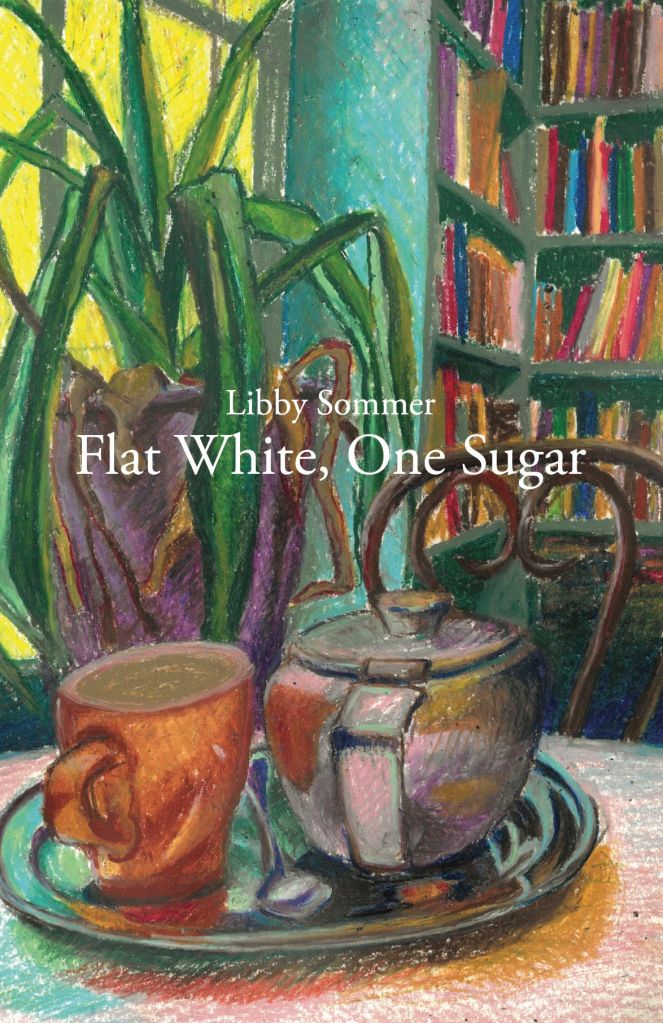
Have a read of my poem ‘Jogger At My Heels’ first published in The Canberra Times. It is one of the poems in my second poetry collection, ‘Flat White, One Sugar’ due for release by Ginninderra Press this year. 51 new poems by me, 21 illustrations by my granddaughter, Natasha Sommer, a graduate of The National Art School.

I hope you enjoy this poem.

Jogger At My Heels:

Each morning he races up the steep

steps of the gully and then down again

on the path I take

to buy my daily newspaper.

I recognise his exhalations just behind

and apologetic grimace running back,

urging me to move aside

to let him through,

but today I understand him

more fully than before.

Hearing my own heavy breathing

as I walk up the gigantic slope

I’m sure he’d like to say, Don’t rush

don’t rush.

… but he’s in too much of a hurry.

Copyright 2024 Libby Sommer

Photo by Nathan Cowley on Pexels.com

Writing Tip: 10 Topics For Writing Practice

close up of pen clasped in writers hand over notebook on her denim lap

Sometimes we sit at our desks to write and can’t think of anything to write about.  We face the blank page.  We sit there until blood pours from our foreheads, as one famous author was heard to say.

Making a list can be good.  It makes you start noticing material for writing in your daily life, and your writing comes out of a relationship with your life in all its richness.

10 ideas for writing practice:

  • Begin with “I don’t remember”. If you get stumped, just repeat the words “I don’t remember” on the page again and keep going.
  • Tell about sound as it arises. Be aware of sounds from all directions as they arise:  sounds near, sounds far, sounds in front, behind, to the side, above or below.  Notice any spaces between sounds.
  • Tell me about last evening. Dinner, sitting on the couch, preparing for bed.  Be as detailed as you can.  Take your time to locate the specifics and relive your evening on the page.
  • Tell me what boredom feels like.
  • See in your mind a place you’ve always loved. Visualise the colours, the sounds, the smells, the tastes.
  • Write about “saying goodbye”. Tackle it any way you like.  Write about your marriage breakup, leaving home, the death of a loved one.
  • What was your first job?
  • Write about the most scared you’ve ever been.
  • Write in cafes. Write what is going on around you.
  • Describe a parent or a child.
  • Some people have a jar full of words written on pieces of paper and select one piece of paper at random each day and write from that.  Others use a line of a poem to start them off.  Then every time they get stuck they rewrite that line and keep going.

Be honest.  Cut through the crap and get to the real heart of things.

Zen Buddhist, psychotherapist, writer and teacher, Gail Sher in her book One Continuous Mistake says the solution for her came via haiku (short unrhymed Japanese poems capturing the essence of a moment).

 “For several years I wrote one haiku a day and then spent hours polishing those I had written on previous days.  This tiny step proved increasingly satisfying,” Gail Sher.

She said it gradually dawned on her that it was not the haiku but the “one per day.”  Without even knowing it, she had developed a “practice.”  Every day, no matter what, she wrote one haiku.  In her mind she became the person who writes “a haiku a day.”  And that was the beginning of knowing who she was.

Gail Sher suggests writing on the same subject every day for two weeks.

“Revisiting the same subject day after day will force you to exhaust stale, inauthentic, spurious thought patterns and dare you to enter places of subtler, more ‘fringe’ knowing,” Gail Sher.

She writes in One Continuous Mistake that the Four Noble Truths for writers are:

  1. Writers write.
  2. Writing is a process.
  3. You don’t know what your writing will be until the end of the process.
  4. If writing is your practice, the only way to fail is to not write.

So start coming up with your own list of ideas for practice writing.  Life happening around us is good grist-for-the-mill.

Header image:  Creative Commons

My Poem ‘Here’

Have a read of my poem ‘Here’, first published in Blue Fringe Art & Literature Exhibition 2021 Collected Works. The poem is also part of my debut poetry collection ‘The Cellist, a Bellydancer & Other Distractions‘ (Ginninderra Press).

I hope you enjoy it.

Here

Each night the train

you cannot see

sounds a final journey

and the lightness which lifts you

in its healing promise all day

lets you down.

Now you pace,

heating up rooms,

pulling down blinds.

Into the silence

with its unknown destination,

conversations not yet had

or imagined.

Midnight threatens,

more enemy than

the worst enemy.

But, you are here now

in this moment.

Copyright 2023 Libby Sommer

Photo by Alex Fu on Pexels.com

Writing Tip: This Writing Life

grey dolphin swimming in the blue ocean

At a literary lunch I overheard someone say:  ‘The thing to do is put the idea in your subconscious.  Your brain will do the work.’

It takes time for our experience to make its way through our consciousness.  For example, it is hard to write about a journey while you are still in the midst of the adventure.  We have no distance from what is happening to us.  The only things we seem to be able to say are ‘having a great time’, ‘the weather is good’, ‘wish you were here’.  It is also hard to write about a place we just moved to, we haven’t absorbed it yet.  We don’t really know where we are, even if we can walk to the train station without losing our way.  We haven’t experienced three scorching summers in this country or seen the dolphins migrating south along the  coast in the winter.

“Maybe away from Paris I could write about Paris as in Paris I could write about Michigan.  I did not know it was too early for that because I did not know Paris well enough.” – Ernest Hemingway, A Moveable Feast  (New York:  Charles Scribner’s Sons, 1964).

So we take in experience, but we need to let things make their way through our consciousness for a while and be absorbed by our whole selves.  We are bower birds, collecting experience, and from the thrown away apple skins, outer lettuce layers, tea leaves, and chicken bones of our minds come our ideas for stories and poems and songs.  But this does not come any time soon.  It takes a very long time (three to ten years in the case of literary fiction).  We need to keep picking through these scraps until some of the thoughts together form a pattern or can be organised around a central theme, something  we can shape into a narrative.  We mine our hidden thoughts for ideas.  But the ideas need time to percolate:  to slowly filter through.

Rumi, the thirteenth-century Sufi poet, summed up what could be the creative process when he wrote ‘The Guest House’:

This being human is a guest house.

Each morning a new arrival.

A joy, a depression, a meanness,

some momentary awareness comes

as an unexpected visitor.

Welcome and entertain them all!

Even if they are a crowd of sorrows,

who violently sweep your house

empty of its furniture,

still, treat each guest honorably.

He may be clearing you out

for some new delight.

The dark thought, the shame, the malice,

meet them at the door laughing and invite

them in.

Be grateful for whoever comes,

because each has been sent

as a guide from beyond.

Jalaluddin Rumi, in The Essential Rumi

Translated by Coleman Barks, 1999

Our work is to keep rummaging through the rubbish bins of our minds, exercising the writing muscle, in readiness to answer that knock at the door when it comes.

As the author Vivian Gornick said:  ‘The writers life is the pits.  You live alone and you work alone, every day I have to recreate myself.’  She paused and laughed.  ‘But when the work is going well there is nothing that compares.’

What about you? Are you ready to answer the knock at the door?  🙂