Have a read of my poem, ‘Electioneering on the Mall’ first published in Quadrant Magazine. ‘Electioneering on the Mall’ is one of the pieces in my recently released second poetry collection, ‘Flat White, One Sugar‘ (Ginninderra Press}.
‘Samuel Beckett, answering a hopeless question from a Paris newspaper – “Why do you write?” – said it was all he was good for: “Bon qu’a ca.” Georges Bernanos said that writing was like rowing a boat out to sea: The shoreline disappears, it is too late to turn back, and the rower becomes a galley slave. When Colette was seventy-five and crippled with arthritis she said that now, at last, she could write anything she wanted without having to count on what it would bring in. Marguerite Yourcenar said that if she had inherited the estate left by her mother and then gambled away by her father, she might never have written another word. Jean-Paul Sartre said that writing is an end in itself. (I was twenty-two and working on a newspaper in Montreal when I interviewed him. I had not asked him the why of the matter but the what.) The Polish poet Aleksander Wat told me that it was like the story of the camel and the Bedouin; in the end, the camel takes over. So that was the writing life: an insistent camel.’ – extract from the Preface of The Selected Stories of Mavis Gallant.
Have a read of my poem, “A Refuge” written during the pandemic and first published in Quadrant Magazine. “A Refuge” is one of the poems in my recently released second collection titled “Flat White, One Sugar” (Ginninderra Press).
Every once in a while, when I’m scratching around for something new to write, I make a list of the things I feel passionate about. The list changes over time, but there are always new ideas to fill the gap.
It’s true that writers write about what they think about most of the time. Things they can’t let go: things that plague them; stories they carry around in their heads waiting to be heard.
Sometimes I used to ask my creative writing groups to make a list of the topics they obsess about so they can see what occupies their thoughts during their waking hours. After you write them down, you can use them for spontaneous writing before crafting them into stories. They have much power. This is where the juice is for writing. They are probably driving your life, whether you realise it or not, so you may as well use them rather than waste your energy trying to push them away. And you can come back to them repeatedly.
One of the things I’m always obsessing about is relationships: relationships in families, relationships with friends, relationships with lovers. That’s what I tend to write about when I’m creating stories. I think to myself, Why not? Rather than repress my obsessions, explore them, go with the flow. And life is always changing, so new material keeps presenting itself.
We are driven by our passions. Am I the only one who thinks this? For me these compulsions contain the life force energy. We can exploit that energy. The same with writing itself. I’m always thinking and worrying about my writing, even when I’m on holidays. I’m driven.
But not all compulsions are a bad thing. Get involved with your passions, read about them, talk to other people about them and then they will naturally become ‘grist for the mill’.
What about you? Do you find yourself telling the same stories over and over again, but from a different perspective?
Have a read of my poem ‘On the Path’ first published in Quadrant Magazine. ‘On the Path’ is one of the poems in my new collection ‘Flat White, One Sugar‘ (Gininnderra Press).
Plot means the story line. When people talk about plotting, they mostly mean how to set up the situation, where to put the turning points, and what the characters will be doing in the end. What happens.
Some fiction writers write organically, not knowing where the story they are writing is going. These writers say it would be boring to know what’s going to happen next and they lose their enthusiasm to tell the story because they know the outcome already. They prefer throwing themselves over the edge and into the void. This method can be very anxiety-producing. It means you need a lot of faith in your process.
Other writers plan the story before they begin. In detective fiction the story definitely needs to be worked out beforehand so information can be drip-fed to the reader.
In the past, when creating my short stories, I have worked organically and not known where my stories were headed as I wrote them. The shorter the piece of fiction, the less need for plot. You can write an interesting story in which not very much happens. A woman fights with her neighbour, a man quits his job, or an unhappy family goes out for a pizza. Simple structures work better than something too complicated when the story is short.
Now that I’m working on a new novel, I feel the need to plot.
“A plot can, like a journey, begin with a single step. A woman making up her mind to recover her father’s oil paintings may be enough to start. The journey begins there, as it did for Raskolnikov in Crime and Punishment when he decided to commit his crime,” Jerome Stern Making Shapely Fiction
The plot grows and develops out of what helps and what hinders the characters’ progress toward their goals.
But how do you know if your draft plot has the right amount of weight to carry an entire novel?
What kind of structures work?
Is there a quick way to design your own plot template?
And how do you handle a book with multiple points of view?
“A good plot has a clear motivation. It has a clear structure. It has an outcome. It has subplots. A good plot looks something like the plot structure template below,” The Writers’ Workshop.
Motivation
Lizzie Bennett wants to marry for love
Plot structure
She meets Darcy & Wickham. She dislikes Darcy, and starts to fall for Wickham. Wickham turns out to be a bad guy; Darcy turns out to be a good guy. She now loves Darcy.
Outcome
She marries Darcy
Subplot 1
Jane Bennett (Lizzie’s nice sister) loves Bingley. Bingley vanishes. He reappears. They get hitched.
Subplot 2
Lydia Bennett (Lizzie’s idiot sister) elopes with Wickham. She’s recovered.
Subplot 3
An idiot, Mr Collins, proposes marriage to Lizzie. She says no. Her friend, Charlotte, says yes.
Of course, there are a lot of things that the above plot template doesn’t tell you. It doesn’t say where the novel is set, it doesn’t tell you anything about plot mechanics – it doesn’t say why Lizzie dislikes Mr Darcy, or how Lydia is recovered from her elopement. It doesn’t have anything to say about character.
The Writers’ Workshop strongly advises us to build a template much like the one above before starting to write. “If you’ve already started your MS then, for heaven’s sake, get to that template right away.”
So I’ve decided to put myself out of my misery and create a Plot Template for my new novel. I already had my characters in place and knew what each character wanted. But now I’m forced into planning an ending, which isn’t a bad thing. Some writers don’t find the real beginning to their stories until they’ve written the endings.
So that’s all we need: a beginning, a middle and an end. Aristotle defined it like this: a beginning is what requires nothing to precede it, an end is what requires nothing to follow it, and a middle needs something both before and after it.
Easy peasy. Not.
*
What about you? Do you plot or write organically? I’d love to hear what works for you and what sends you straight to the Writers Block Corner.
Have a read of my poem “When Will It End?” first published in Quadrant Magazine. I wrote the poem in response to the war in Ukraine. “When Will It End” is one of the poems in my second poetry collection “Flat White, One Sugar” (Ginninderra Press).
I hope you like it.
When Will It End?
The woman is weeping for her husband,
his ashes lined up with the unclaimed
urns at the crematorium.
How could this happen again?
The man is weeping for his dead wife
& unborn child stretchered out from
the bombed maternity hospital.
The woman says, “We had to flee. His ashes
were left behind.”
What use is a city of rubble?
The brother is weeping beside his mother at the grave
of his twin. The brothers had strapped on fatigues,
Sometimes when people read my stories they assume those stories are me. They are not me, even if I write in the first person. They were my thoughts and feelings at the time I wrote them. But every minute we are all changing. There is a great freedom in this. At any time we can let go of our old selves and start again. This is the writing process. Instead of blocking us, it gives us permission to move on. Just like in a progressive ballroom dance: you give your undivided attention to your partner—keep eye contact for the time you are dancing together—but then you move on to the next person in the circle.
The ability to express yourself on the page—to write how you feel about an old lover, a favourite pair of dance shoes, or the memory of a dance on a chilly winter’s night in the Southern Highlands—that moment you can support how you feel inside with what you say on the page. You experience a great freedom because you are not suppressing those feelings. You have accepted them, aligned yourself with them.
I have a poem titled ‘This is what it feels like’—it’s a short poem. I always think of it with gratitude because I was able to write in a powerful way how it was to be desperate and frightened. The act of self expression made me feel less of a victim. But when people read it they often say nothing. I remind myself, I am not the poem, I am not the stories I write. People react from where they are in their own lives. That’s the way things are. The strength is in the act of writing, of putting pen to paper. Write your stories and poems, show them to the world, then move on. The stories are not you. They are moments in time that pass through you.
Have a read of my poem, ‘Transience’ first published in Quadrant Magazine. ‘Transience’ is one of the poems in my second collection titled ‘Flat White, One Sugar‘ (Ginninderra Press).
In the Saturday-afternoon feedback group recently, we talked about the ‘off with his head’ or ‘out-it-goes’ part of writing. We acknowledged that as a group we’d always been very supportive and encouraging of each others work. That was because we were all in it together. Our critiquing was not telling lies; it was from a place of open hearted acceptance. Everything you put on the page is acceptable.
Sometimes someone says, ‘I want a rigorous no-holds-barred assessment of my work.’ But what do you say to them when the writing is dull and boring? Don’t give up your day job? It doesn’t sit comfortably with most of us to be directly critical of someone’s writing. It’s like telling someone how ugly their baby is. All of us find it hard to separate our writing from ourselves, and are prone to take criticism personally.
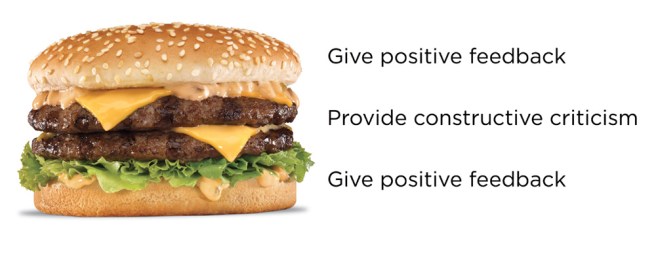
The feedback sandwich is a widely known technique for giving constructive feedback, by ‘sandwiching’ the criticism between two pieces of praise or compliments.
Yesterday, as we passed around copies of our work (just a page or two) we started to address what William Faulkner famously said:
‘In writing, you must kill all your darlings.’
First of all, we looked for the juice in each piece. Where did the writing come alive? ‘Get rid of the rest,’ we said. ‘Off with his head—out it goes.’ It’s very difficult to be this honest, and not everyone wants to hear it. ‘I simply want gentle support and a few corrections,’ some of us might say.
Be willing to have the courage to look at your work with truthfulness. It’s good to know where your writing has energy and vitality, rather than to spend a lot of time trying to make something come to life that is dead on the page. Keep writing. Something new will come up. You don’t want to put your readers to sleep by writing a lot of boring stuff.
Are you in a critique group to give you feedback on your writing? Do you find it useful?