Around Midnight

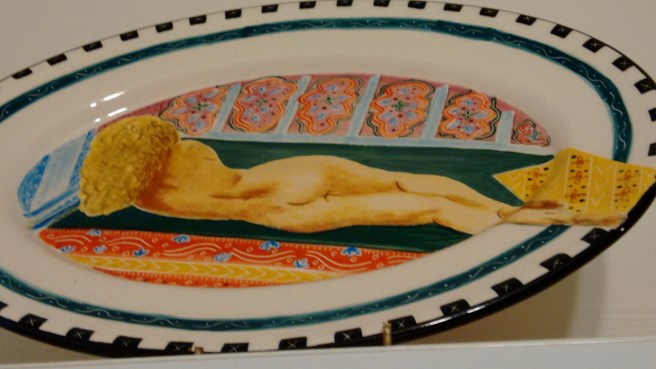
painting of nude reclining woman on ceramic platter
Ceramic painting by Libby Sommer 2008


‘When are you open?’ Anny asks the woman on the telephone.

‘We have a party twice a day.  Every day.  Twelve thirty to four thirty and seven thirty to midnight.’

‘Oh.  Every day?  I thought it was Saturday nights only.’

‘No darling.  Every day.’

‘So what’s the setup?’

‘$120 for a couple.  Nothing if you come on your own.  What’s your position.  How would you come along?’

‘On my own.’

‘It would cost you nothing then.’

‘But what do you do?  I mean, I know what goes on there.’

‘You’ve been here before?’

‘No.  A friend told me about it.  What do you wear?  What’s the setup?’

‘It’s all up to you love.  If you fancy a gentleman you invite him into one of the rooms.’

‘What do you wear though?  My friend said something about robes.’

‘Towels. They’re towels love.  You wear whatever you like.  Normal clothes.’

Continue reading

How to Beat Resistance

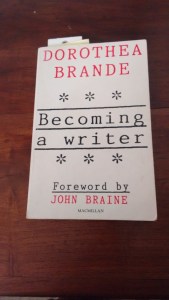
white book on wooden table

How many wonderful ideas have we had in our lives that never became anything more than ideas?  What stopped them from becoming reality?  Probably lack of drive, or fear, or both.

If the idea of writing a story, writing a memoir, or writing a blog lights a spark within you, sets off a signal, causes you to drool—or fills you with unspeakable anxiety—then you are ready to write.  What is holding you back is not lack of drive, but fear.  Unadulterated, stark fear.


  • Fear of what?
  • Fear of being unable to write well and being criticized by others?
  • Fear of being unable to stay on track long enough to get to an ending?
  • Fear that you just don’t have what it takes to maintain focus to tell a good story?


Research into the way the brain operates has revealed that there are two sides to the brain, left and right.  Much of our fear of writing comes from the way these two sides do or don’t work together.

Continue reading

After the Rain

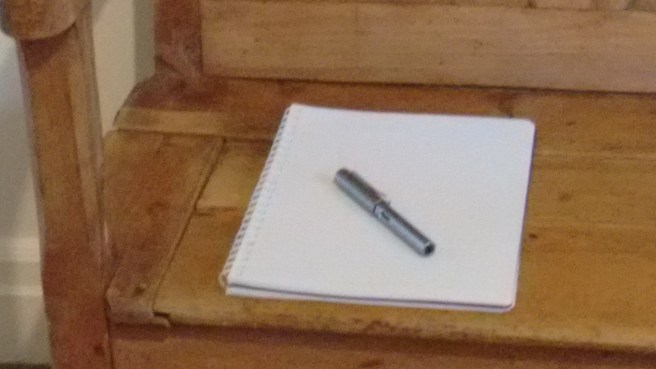
silver pen on writing pad on antique pine settle

Just before six o’clock on Friday evening, Anny and Gordon get out of Anny’s Honda.  They walk down Bondi Road passing the tattoo shop, the vegetarian restaurant and yet another new Thai restaurant.  The road is unusually quiet and Anny has parked directly opposite the fish cafe where she’s taking Gordon for dinner.  The streets aren’t grid locked during the Olympics after all and there’s an unusual calm on this usually noisy busy road.

Walk in front of me, says Gordon as they head towards the traffic lights and the pedestrian crossing.  I can see better if you walk slightly in front of me.

She doesn’t know whether to offer him her arm or what.  She feels embarrassed at the thought of close physical contact with him and is pleased that he’s told her to walk in front.  At least she knows now the best way to progress along the street with him.  Not like the snail’s pace of the week before.

Continue reading

10 Topics for Writing Practice

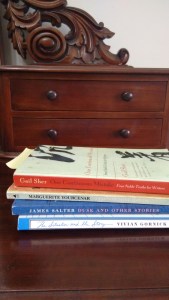
books on Victorian mahogoney dressing table

Sometimes we sit at our desks to write and can’t think of anything to write about.  We face the blank page.  We sit there until blood pours from our foreheads, as one famous author was heard to say.


Making a list can be good.  It makes you start noticing material for writing in your daily life, and your writing comes out of a relationship with your life in all its richness.


10 ideas for writing practice:

  1. Begin with “I don’t remember”. If you get stumped, just repeat the words “I don’t remember” on the page again and keep going.
  2. Tell about sound as it arises. Be aware of sounds from all directions as they arise:  sounds near, sounds far, sounds in front, behind, to the side, above or below.  Notice any spaces between sounds.
  3. Tell me about last evening. Dinner, sitting on the couch, preparing for bed.  Be as detailed as you can.  Take your time to locate the specifics and relive your evening on the page.
  4. Tell me what boredom feels like.
  5. See in your mind a place you’ve always loved. Visualise the colours, the sounds, the smells, the tastes.
  6. Write about “saying goodbye”. Tackle it any way you like.  Write about your marriage breakup, leaving home, the death of a loved one.
  7. What was your first job?
  8. Write about the most scared you’ve ever been.
  9. Write in cafes. Write what is going on around you.
  10. Describe a parent or a child.

Continue reading

Work-Out

books on bedside table in front of painting of vase of flowers

FORTNIGHTLY SHORT STORY

Work-Out by Libby Sommer

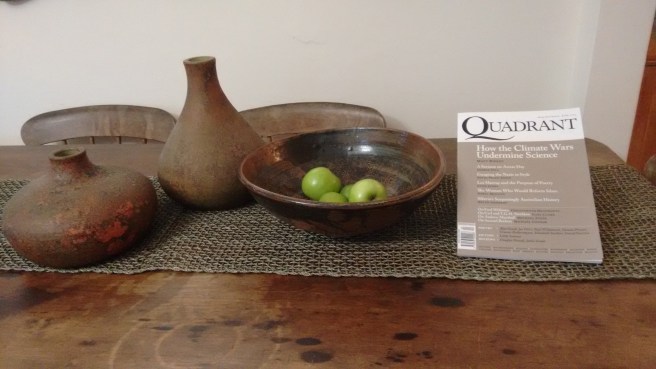
first published in Quadrant


You run up the stairs to the gym avoiding the women and men from the previous class rushing down the stairs.  Keep to the left.  Give your membership card to the girl at the desk and then in through the turnstile.  Rummage for the $2 coin in your bag that works the locker.  Insert the money, leave the bag, take the towel and the bottle of water and the book to read then up the stairs to the third floor to the exercise bikes all the time hoping there’ll be a reclining bicycle free and not one of those awful uprights that hurt your bum.  Sit on the bike read your book, wipe the sweat off your face, drink from the bottle, look out the window to the workers erecting a block of apartments that are gradually blocking the view of the harbour. Warm up for 60 seconds on a low speed, then 20 minutes at a higher speed and a sixty second cool down.  Then into the main gym for the body power class.  Get a step, four platforms, a rubber mat and a long weights bar.  Two large discs, four small discs.  Stand up the front so you can see yourself in the mirror and in front of the fan.  Fight for this prime position. First the warm up, then legs, lunges, squats, chest, back, shoulders, legs, triceps, biceps, stomach.  Bend from the hips.  Clean and press.  Dead rows.   Wipe the sweat from your face, adjust the bar across your shoulders.  Knees over toes as you squat.  Straight back, stomach in to support the back, shoulders back, head up out of the neck.  Concentrate on the music, the instructor speaking, the fan in front of you.  Watch yourself in the mirror, the women beside you and behind.  Check out how old they are and if their weights are heavier or lighter.  Smell the sweat.  Swallow the water.  A quick stretch between tracks.  Calfs, quads, shoulders and back.  Lie down on the platform for the chest track.  Use your nipples as markers.  Down to the markers, up slowly.  One, two three up and then slowly down.  Vary the rhythm.

Continue reading

Short Story or Novel

post8pic

Is a novel a short story that keeps going, or, is it a string of stories with connective tissue and padding, or, is it something else?  Essayist Greg Hollingshead believes that the primary difference between the short story and the novel is not length but the larger, more conceptual weight of meaning that the longer narrative must carry on its back from page to page, scene to scene.

“It’s not baggy wordage that causes the diffusiveness of the novel.  It’s this long-distance haul of meaning.”  Greg Hollingshead

There is a widespread conviction among fiction writers that sooner or later one moves on from the short story to the novel.  When John Cheever described himself as the world’s oldest living short story writer, everyone knew what he meant.

Continue reading

Towards the End

Post7pic

He leaned back on the chrome chair, stretched his legs out under the square black table and placed his mobile phone in front of him. He looked over to the counter at the back of the cafe at the cakes and muffins on display and the Italian biscuits in jars. He turned back to the glass windows and wondered if he had the guts to tell her today. He wanted to. By Christ he wanted to. He straightened up, his elbows on the table, his hands clasped together in front of his face. There’d been some good times, that’s for sure. But what the heck. A man’s got to do what a man’s got to do.

The sliding glass door clanked open and Anny walked in. He looked over at her, first from the rear as she closed the door and then as she approached, her face flushed, her dark hair flying back from her shoulders. Not bad looking. A bit on the heavy side but not a bad looker all the same. Yes, there’d been some good times. Especially in the sack.

Continue reading

Exercising the Writing Muscle

Post6pic

Writing as a daily practice is a way to exercise the writing muscle. Like working out at the gym, the more you do it, the more results you get. Some days you just don’t feel like working out and you find a million reasons not to go to the gym or out for a jog, a walk, a swim, a bike ride, but you go anyway. You exercise whether you want to or not. You don’t wait around till you feel the urge to work out and have an overwhelming desire to go to the gym. It will never happen, especially if you haven’t been into health and fitness for a long time and you are pretty out of shape. But if you force yourself to exercise regularly, you’re telling your subconscious you are serious about this and it eventually releases its grip on your resistance. You just get on and do it. And in the middle of the work out, you’re actually enjoying it. You’ve felt the endorphines kick in. When you get to the end of the jog, the walk, the bike ride, the swim, the gym workout or the Pilates, Yoga or Zumba class, you don’t want it to end and you’re looking forward to the next time.

That’s how it is with writing too. Once you’ve got the flow happening, you wonder why it took you so long to turn up on the page. Bum on chair is what I say to my writing students. Through daily practice your writing does improve.

Continue reading

Art and the Mermaid

mermaid2

FORTNIGHTLY SHORT STORY

Art and the Mermaid by Libby Sommer

first published in Quadrant

Once upon a time it came to pass, so it is said, that an enormous storm swept the coast of New South Wales, doing extensive damage to the ocean beaches – destroying jetties, breakwaters and washing away retaining walls.  Mountainous seas swept Bondi Beach and dashed against the cliffs carrying ruin with every roller.  At North Bondi near Ben Buckler a huge submerged block of sandstone weighing 233 tons was lifted ten feet and driven 160 feet to the edge of the cliff where it remains to this day.

One day a Sydney sculptor, Lyall Randolph, looked upon the rock and was inspired.  The sculptor was a dreamer.  Let us, he said, have two beautiful mermaids to grace the boulder.  Using two Bondi women as models he cast the two mermaids in fibreglass and painted them in gold.

Continue reading

Autobiography in Fiction

Post4pic

When people ask me where I get my ideas from, I tell them I use the world around me. Life is so abundant, if you can write down the actual details of the way things were and are, you hardly need anything else. Even if you relocate the French doors, fast-spinning overhead fan, small red Dell laptop, and low black kneeling chair from your office that you work in in Sydney into an Artist’s Atelier in the south of France at another time, the story will have truth and groundedness.

In Hermione Hoby’s interview with Elizabeth Strout in last Saturday’s Guardian newspaper the Pulitzer prize winner said her stories have always begun with a person, and her eyes and ears are forever open to these small but striking human moments, squirreling them away for future use. “Character, I’m just interested in character,” she said.

Continue reading