The day is softening into night, my desk in shadow as the sun moves behind the building. Birds hover in the trees as the wind blows across the surface of the sea. It’s hard to know which way to go. Every day I fear that I can’t do it. So I’m watching as it gets dark.
Tonight I’m thinking about the saddest bits. Thinking, for example, that the night was alight with thunder. Lightening cracked the sky. Just a flash and then darkness again.
You can forget it in some bookshelf or other for many years, so that one day your children or grandchildren can pick it up by chance and remind you of it.
Here is an important writing tip: ground your writing in a sense of place, whether landscape or cityscape.
How often have you heard someone say of a book they loved: ‘I felt like I was there.’
Even if you relocate the poodle tied to a fake-cane chair, the sound of a game of tennis, the table of older men after their regular Sunday match at the café overlooking the tennis courts at Cooper Park that you drank a lemongrass and ginger tea at in Sydney into a café in a story in another state and time, the story will have originality and believability. ‘But that café was in Sydney, I can’t transport it to Adelaide.’ But you can. You can have flexibility with specific detail. The mind is able to transport details, but using actual places that you experienced will give your writing authenticity and truthfulness. It grounds your work in place, giving life and vitality to your writing, rather than a whole lot of exposition that floats in the air.
If you don’t create evocative settings, your characters seem to have their conversations in vacuums or in some beige nowhere-in-particular. – Jerome Stern
Creation of the physical world is as important to your story as action and dialogue. If your readers can be made to see the hand-knitted socks or the row of vitamins on the kitchen benchtop, the scene becomes alive. Readers pay attention. Touch, sound, taste, and smell make readers feel as if their own feet are warm under the cold sheets.
‘Place situates the story in your reader’s mind. Fiction that seems to happen in no particular place often seems not to take place at all.’ – Jerome Stern
Re-blogging and other sharing options are important to getting and maintaining blog readership. Re-blog is a powerful tool. Only recently have I come to appreciate the power of allowing my posts to be shared by others. Along the way, I have also learned other things that may be helpful to WordPress bloggers. So I am sharing my thoughts on sharing options.
I’ve never told anyone. To think about it makes my hands sweat and nausea rise from my stomach. It happened the year I turned eighteen on a sunny late afternoon in February, on the top floor of a building in Double Bay. I was recently engaged to be married and the wedding was booked for the end of June. We had gone to the photographer’s studio to have our engagement photos taken. The photographer was a good friend of my future brother-in-law. I had met him several times before and had thought of him as old, as my parents seemed to be old, but he can’t in those days have been more than fifty. He was tiny like a jockey, his trademark cravat tied at the neck beneath a tailored shirt. His accent, foreign but very English. His shirt covered the numbers branded on his arm – a childhood survivor of the holocaust. Continue reading →
Yesterday afternoon in the Saturday-afternoon feedback group, we began talking about the ‘off with his head’ or ‘out-it-goes’ part of writing. We acknowledged that as a group we’d always been very supportive and encouraging of each others work. That was because we were all in it together. Our critiquing was not telling lies; it was from a place of open hearted acceptance. Everything you put on the page is acceptable.
Sometimes someone says, ‘I want a rigorous no-holds-barred assessment of my work.’ But what do you say to them when the writing is dull and boring? Don’t give up your day job? It doesn’t sit comfortably with most of us to be directly critical of someone’s writing. It’s like telling someone how ugly their baby is. All of us find it hard to separate our writing from ourselves, and are prone to take criticism personally.
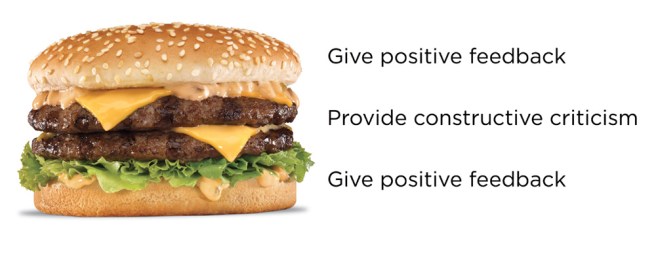
The feedback sandwich is a widely known technique for giving constructive feedback, by ‘sandwiching’ the criticism between two pieces of praise or compliments.
Yesterday, as we passed around copies of our work (just a page or two) we started to address what William Faulkner famously said:
‘In writing, you must kill all your darlings.’
First of all, we looked for the juice in each piece. Where did the writing come alive? ‘Get rid of the rest,’ we said. ‘Off with his head—out it goes.’ It’s very difficult to be this honest, and not everyone wants to hear it. ‘I simply want gentle support and a few corrections,’ some of us might say.
Be willing to have the courage to look at your work with truthfulness. It’s good to know where your writing has energy and vitality, rather than to spend a lot of time trying to make something come to life that is dead on the page. Keep writing. Something new will come up. You don’t want to put your readers to sleep by writing a lot of boring stuff.
He’s waiting at the bottom of the ramp, just inside the steel fence that cordons off the entry to the station. He said to give him a ring from her mobile when the train passed Gosford. She quickens her pace, adjusts the overnight bag on her shoulder. She is close enough to see the soft fold of his graying hair, the clear smooth glow of his skin. In his white socks and slip-on loafers he looks very English. Continue reading →
Every once in a while, when I’m scratching around for something new to write, I make a list of the things I obsess about. Thankfully, some of them change over time, but there are always new ones to fill the gap.
It’s true that writers write about what they think about most of the time. Things they can’t let go: things that plague them; stories they carry around in their heads waiting to be heard. Continue reading →
One can never change the past, only the hold it has on you. And while nothing in your life is reversible, you can reverse it nevertheless – Merle Shain.
1.
I’m imagining a cloudy autumn morning. There’s a room. Half office, half bedroom. Not too large and not too small. The windows of the room face east and look out towards the ocean across the expanse of a green gully.
I picture a woman sitting on a bed with pillows behind her back. The windows are open. Perhaps it is Saturday morning. On the bedside table is a mug of tea and a photograph of the woman’s daughter on her wedding day.
Sometimes there is a person in one of my creative writing classes who is obviously very talented. I can bring to mind one in particular. You could sense people holding their breath as she read, and often her hands shook. The writing process opened her up. She said she had wanted to write for years. She was so excited about writing that she straight away wanted to write a book. I said to her, slow down. Just practice writing for a while. Learn what this is all about.
In Japan becoming an itamae of sushi requires years of on-the-job training and apprenticeship. After five years spent working with a master or teacher itamae, the apprentice is given his first important task, the preparation of the sushi rice.
Writing, like becoming a Sushi Chef, is a life’s work and takes a lot of practice. The process is slow, and at the start you are not sure what you are making.
Futomaki (“thick roll” – rice on inside, nori on the outside)
Uramaki (“inside-out roll” – rice on outside, nori on the inside)
Temaki (“hand roll” – cone-shaped roll)
That’s how it was for me. I thought I could jump in and write a book in 6 months. In fact, it’s taken me 20 years to write a publishable manuscript: ‘My Year With Sammy’, the story of a difficult yet sensitive child, published by Ginninderra Press last year.
So cut yourself some slack before you head off on a writing marathon.
Writing is like learning to prepare the rice for sushi: the apprenticeship is long, and in the beginning you are not sure whether a Futomaki, a Uramaki or a Temaki will be the end result.