Ground Your Writing In Place

person holding silver retractable pen in white ruled book

Here is an important writing tip:  ground your writing in a sense of place, whether landscape or cityscape.

How often have you heard someone say of a book they loved:  ‘I felt like I was there’?

Even if you relocate the poodle tied to a fake-cane chair, the sound of a game of tennis, the table of older men after their regular Sunday match at the café overlooking the tennis courts at Cooper Park that you drank a lemongrass and ginger tea at in Sydney into a café in a story in another state and time, the story will have originality and believability.  ‘But that café was in Sydney, I can’t transport it to Adelaide.’  But you can.  You can have flexibility with specific detail.  The mind is able to transport details, but using actual places that you experienced will give your writing authenticity and truthfulness.  It grounds your work in place, giving life and vitality to your writing, rather than a whole lot of exposition that floats in the air.

 If you don’t create evocative settings, your characters seem to have their conversations in vacuums or in some beige nowhere-in-particular. –  Jerome Stern

Creation of the physical world is as important to your story as action and dialogue.  If your readers can be made to see the hand-knitted socks or the row of vitamins on the kitchen benchtop, the scene becomes alive.  Readers pay attention.  Touch, sound, taste, and smell make readers feel as if their own feet are warm under the cold sheets.

Place situates the story in your reader’s mind.  Fiction that seems to happen in no particular place often seems not to take place at all.’ –  Jerome Stern

Do you agree?

My Prose Poem: ‘Sixteen Is A Very Difficult Age, You Know’

alone animal bird clouds

So what is a prose poem? According to the Poetry Foundation, a prose poem is a prose composition that, while not broken into verse lines, demonstrates other traits such as symbols, metaphors, and other figures of speech common to poetry.

If you are able to distill meaning in a very short form, you may enjoy writing prose poetry.

Have a read of my prose poem Sixteen Is A Very Difficult Age, You Know, first published in Quadrant magazine September 2018.

Sixteen Is a Very Difficult Age, You Know

Well yes it is. This time of year isn’t easy either. It has most of us by the neck.  You don’t want to get sick at Christmas. They said he needs six weeks of intensive therapy then they’ll decide about medication. How – when everything’s closed till February? Yes, he’s up and down. Better some days, but hardly ever. They said hide all the tablets and remove the kitchen knives. I ring or text to see how he’s going. He doesn’t always pick up. Don’t refer to the incident. Wait for him to say something. Well, he doesn’t say much though he’ll let me give him a hug – sometimes. So here I am trying to gather his forgotten dreams from the air. They’re drifting just outside my reach.

Copyright © 2018 Libby Sommer


Writing Tip: Use Your Obsessions

woman reading a book in the bed

Every once in a while, when I’m scratching around for something new to write, I make a list of the things I obsess about.  Thankfully, some of them change over time, but there are always new ones to fill the gap.

Recently, of course, all I can think about is the pandemic and the changes to the world as we’ve known it.

It’s true that writers write about what they think about most of the time.  Things they can’t let go: things that plague them; stories they carry around in their heads waiting to be heard.

I used to get my creative writing groups to make a list of the topics they obsess about so they can see what occupies their thoughts during their waking hours.  After you write them down, you can use them for spontaneous writing before crafting them into stories.  They have much power.  This is where the juice is for writing.  They are probably driving your life, whether you realise it or not, so you may as well use them rather than waste your energy trying to push them away.  And you can come back to them repeatedly.

I’ve been working on a suite of quarantine poems. The first of the series will be published in Quadrant magazine.

One of the things I usually obsess about is relationships:  relationships in families, relationships with friends, relationships with lovers.  That’s what I tend to write about.  I think to myself, Why not?  Rather than repress my obsessions, explore them, go with the flow.  And life is always changing, so new material keeps presenting  itself.

We are driven by our passions.  Am I the only one who thinks this?  For me these compulsions contain the life force energy.  We can exploit that energy.  The same with writing itself.  I’m always thinking and worrying about my writing, even when I’m on holidays.  I’m driven.

But not all compulsions are a bad thing.  Get involved with your passions, read about them, talk to other people about them and then they will naturally become ‘grist for the mill’.

What about you?  Do you find yourself writing about the same things over and over again?

Poem: Bronte Beach


cafes, buses, palm trees, bright blue sky, cars on Bronte Road, Bronte

I like to create a strong sense of place when I write. I find it grounds my stories and poems. Pre-pandemic, Bronte Beach was one of my favourite homes-away-from-home. I used to hang out in a cafe there writing in my notebook. My poem Bronte Beach is entirely grounded in place.  It was first published in Wild anthology (Ginninderra Press,  2018). Have a read. Hope you enjoy it.


Bronte Beach:

The surf’s been hammered by rain,

and along the pavement open-faced cafes wedge side by side:

compact, glass-fronted, in flattened

Art Deco buildings, with competing blackboard menus.

Rain drips from the edge of the canvas awning,

and a smell of fried fish in rancid oil

through the mouth of the sliding door

as an oversized bus pulls in and blocks the view.

Marooned on the swell are wet-suited board riders,

unwavering as the cliff face above the rocks that define the beach.

Beyond the rock pool the waves

remain stubbornly low spreading a shallow calm.

The rain settles, rusting roof racks in the salt air,

and those expired meters will upset the fattened

people-who-lunch in the darkening afternoon.

All day the treacherous ocean scours

the man-made sea pool, where

all-weather swimmers scan the water

for migrating dolphins or whales.

A white-hulled speedboat appears

in the grey-blue, travelling north,

and the black-clad board riders wait,

grounded, legless pigeons who can,

in a heartbeat, fan their iridescent wings.

Squabbling seagulls swoop and dive

and chase each other between the palms,

each white slow and steady flap of wings

picked up by the whiteness of the backwash

of the speed boat out there on the pastel-pink ocean,

disappearing behind the haze.


Copyright 2018 Libby Sommer


Writing Tip: Critiquing

woman lying on green grass while holding pencil

In the Saturday feedback group, we began talking about the ‘off with his head’ or ‘out-it-goes’ part of writing.  We acknowledged that as a group we’d always been very supportive and encouraging of each others work.  That was because we were all in it together.  Our critiquing was not telling lies; it was from a place of open-hearted acceptance.  Everything you put on the page is acceptable.

Sometimes someone says, ‘I want a rigorous no-holds-barred assessment of my work.’  But what do you say to them when the writing is dull and boring?  Don’t give up your day job?  It doesn’t sit comfortably with most of us to be directly critical of someone’s writing.  It’s like telling someone how ugly their baby is.  All of us find it hard to separate our writing from ourselves, and are prone to take criticism personally.

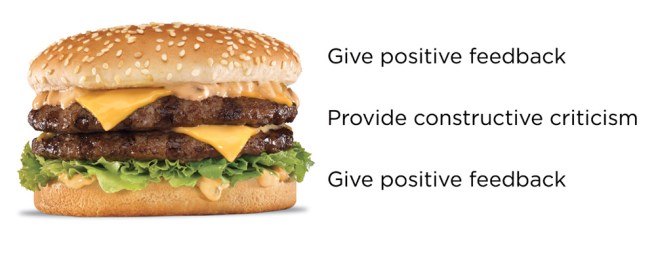
The feedback sandwich is a widely known technique for giving constructive feedback, by ‘sandwiching’ the criticism between two pieces of praise or compliments.


hamburger with cheese and two beef patties

Yesterday, as we passed around copies of our work (just a page or two) we started to address what William Faulkner famously said:

‘In writing, you must kill all your darlings.’

First of all, we looked for the juice in each piece.  Where did the writing come alive?  ‘Get rid of the rest,’ we said.  ‘Off with his head—out it goes.’   It’s very difficult to be this honest, and not everyone wants to hear it.  ‘I simply want gentle support and a few corrections,’ some of us might say.

Be willing to have the courage to look at your work with truthfulness.  It’s good to know where your writing has energy and vitality, rather than to spend a lot of time trying to make something come to life that is dead on the page.   Keep writing.  Something new will come up.    You don’t want to put your readers to sleep by writing a lot of boring stuff.

Do you have a writing group? Do you find it useful?

Poem: Between the Islands of the Pacific

sky, clouds, rising sun over Pacific Ocean

Not that most of us are in a rush to sign up for a cruise any time soon … but here is my poem, BETWEEN THE ISLANDS OF THE PACIFIC, first published in Quadrant magazine June, 2018. It’s sort of relevant to the current situation. Hope you enjoy it.


Between the Islands of the Pacific


Because by now we know everything is not so blue

out here.


The cities had tipped rubbish into the sea,

and we let them without even noticing.


Not even feeling our breathing clear

as gusts reaching ten knots cleaned up our days.


Not even. Today pure blue sky, blue sea,

out there the horizon drawing a line

below the clouds, the absoluteness of it. Nights

of diesel engines shuddering beneath us.


We lounge on chairs side by side on the deck.

At dusk, we stand at the railing of the ship as the sun

slips into the ocean. In the fresh sea air, their backs turned,

some raise a selfie-stick or light a cigarette while others

stand holding their breath.


Where can we go from here, and how?


Copyright © Libby Sommer 2018


Writing Tip: The Inner Critic

man with hand on temple looking at laptop

It is essential to separate the creator and the editor, or inner critic when you practice writing, so that the creator has plenty of room to breathe, experiment, and tell it like it really is.  If the inner critic is being too much of a problem and you can’t distinguish it from your authentic writing voice, sit down whenever you find it necessary to have some distance from it and put down on paper what the critic is saying, put a spotlight on the words—“You have nothing original to say, what made you think you could write anything anyone would want to read, your writing is crap, you’re a loser, I’m humiliated, you write a load of rubbish, your work is pathetic, and your grammar stinks …”  On and on it goes!

Say to yourself, It’s OK to feel this.  It’s OK to be open to this.

You can learn to cultivate compassion for yourself  during this internal process by practicing Mindfulness Meditation.  Sit up straight, close your eyes, bring your awareness to your inner experience.  Now,  redirect your attention to the physical sensations of the breath in the abdomen … expanding as the breath comes in … and falling back as the breath goes out.  Use each breath to anchor yourself in the present.   Continue, concentrating on the breath for several minutes.  Now, expand your field of awareness to include the words of the inner critic.  Turn your attention to where in your body you feel the unpleasant thoughts, so you can attend, moment by moment, to the physical reactions to your thoughts.

 “Stay with the bodily sensations, accepting them, letting them be, exploring them without judgment as best you can.”—Mindfulness, Mark Williams and Danny Penman.

Every time you realise that you’re judging yourself, that realisation in itself is an indicator that you’re becoming more aware.

The thing is, the more clearly you know yourself, the more you can accept the critic in you and use it.  If the voice says, “You have nothing interesting to say,” hear the words as white noise, like the churning of a washing machine.  It will change to another cycle and eventually end, just like your thoughts that come and go like trains at the station.  But, in the meantime, you return to your notebook and practice your writing.  You put the fear and the resistance down on the page.

*

Do you struggle with an inner critic?  Any words of wisdom you’d like to share?

A Poem

woman in white shirt and blue denim short shorts sitting

Hello everyone. Hello to all you fellow quarantiners hanging-in-there.

I’d like to share with you my poem ELSEWHERE, first published in Quadrant magazine in December 2017. Hope you like it. The poem is relevant to today’s situation, in many ways.


Elsewhere

Hair remembers how dark a room becomes

when hair is not let loose, straw fallen from the head

of a broom, drifting onto a path,

crunched underfoot by someone who never realised

it was straw. Hair drank, jogged,

ate by itself, knew how to tick ‘Like’

on Social Media. But hair felt

out of touch with itself

unable to distinguish the difference between

fear of the unknown, and fear of something

bad. Hair remembered the ultramarine blue of sea and sky

and the hundred varieties of tuna, calamari and squid.


Hair has dreams, that’s what hair does.

Covers over a shiny scalp, frames the face.

Adventure means exploration and discovery.

And hair remembers—blankets of humidity, harsh light,

residing there in the brain’s temporal lobes.

Even now, when hair is back home,

it remembers the wanting things to remain the same

but gives thanks for faraway places

where you can untangle and restyle yourself.


© Libby Sommer 2017

Stay safe and be well.

I Am Not the Stories I Tell

pexels-photo.jpg

Sometimes when people read my stories they assume those stories are me.  They are not me, even if I write in the first person.  They were my thoughts and feelings at the time I wrote them.  But every minute we are all changing.  There is a great freedom in this.  At any time we can let go of our old selves and start again.  This is the writing process.  Instead of blocking us, it gives us permission to move on.  Just like in a progressive ballroom dance:  you give your undivided attention to your partner—keep eye contact for the time you are dancing together—but then you move on to the next person in the circle.

The ability to express yourself on the page—to write how you feel about an old lover, a favourite pair of dance shoes, or the memory of a dance on a chilly winter’s night in the Southern Highlands—that moment you can support how you feel inside with what you say on the page.  You experience a great freedom because you are not suppressing those feelings.  You have accepted them, aligned yourself with them.

I have a poem titled ‘This is what it feels like’—it’s a short poem.  I always think of it with gratitude  because I was able to write in a powerful way how it was to be desperate and frightened.  The act of self expression made me feel less of a victim.  But when people read it they often say nothing.  I remind myself, I am not the poem, I am not the stories I write.  People react from where they are in their own lives.  That’s the way things are.  The strength is in the act of writing, of putting pen to paper.   Write your stories and poems, show them to the world, then move on.  The stories are not you.  They are moments in time that pass through you.

My Poem: ‘Lying On A Harbour Beach at Noon’

painting of girl lying on beach in torquoise bikini reading a book

During the pandemic I find myself turning more and more to poetry, the reading and the writing of poetry.

Here is my poem Lying On A Harbour Beach At Noon, first published in Quadrant magazine January 2017.

Hope you enjoy it.


Lying On A Harbour Beach At Noon


There is an opening out of the self which happens

when the sun is high in a cloudless blue

and its warmth sinks into the body.


It occurs on a gentle beach.

It is a slow opening,

like waking up in

your own cosy apartment.

When all the tenants wake up

and the blinds snap

the windows open wide.

If you are in bed you struggle to open to the bright light.

If you are elsewhere, feeling your separateness, alienated,

you long for home and think you’re falling apart.


You are not falling apart.

You could open into your own particular self,

feel your skin move away from the bone,

your belly like an open wound tightening

then opening with everything exposed.

You know you can stop the empty grasping if you want to

because you have a deep knowing,

you open to it, and for now

it holds you gently.


Copyright 2017 Libby Sommer


Stay safe everyone, and be well.