Have a read of my poem, ‘Safe … The Pandemic’ first published in ‘Milestones’ Anthology (Ginninderra Press). It is also one of the poems in my debut collection, ‘The Cellist, a Bellydance & Other Distractions‘ (Ginninderra Press).
Is a novel a short story that keeps going, or, is it a string of stories with connective tissue and padding, or, is it something else? Essayist Greg Hollingshead believes that the primary difference between the short story and the novel is not length but the larger, more conceptual weight of meaning that the longer narrative must carry on its back from page to page, scene to scene.
“It’s not baggy wordage that causes the diffusiveness of the novel. It’s this long-distance haul of meaning.” Greg Hollingshead
There is a widespread conviction among fiction writers that sooner or later one moves on from the short story to the novel. When John Cheever described himself as the world’s oldest living short story writer, everyone knew what he meant.
Greg Hollingshead says that every once in a while, to the salvation of literary fiction, there appears a mature writer of short stories—someone like Chekhov, or Munro—whose handling of the form at its best is so undulled, so poised, so capacious, so intelligent, that the short in short story is once again revealed as the silly adjective it is, for suddenly there are simply stories, spiritual histories, narratives amazingly porous yet concentrated and undiffused.
When you decide you want to write in a particular form—a novel, short story, poem—read a lot of writing in that form. Notice the rhythm. How does it begin? What makes it complete? When you read a lot in a particular form, it becomes imprinted inside you, so when you sit at your desk to write, you produce that same structure. In reading novels your whole being absorbs the pace of the sentences, the setting of scenes, knowing the colour of the bedspread and how the writer gets her character to move down the hallway to the front door.
I sit at my desk thinking about form as a low-slung blanket of cloud blocks my view of the sky. Through the fly screen I inhale the sweet smell of earth after rain as another day of possibility beckons.
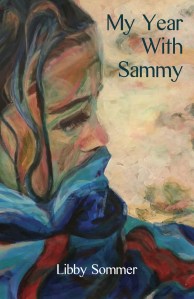
We might write five novels before we write a good one. I wrote five book-length manuscripts before one was finally accepted for publication. My skill was in the short form. I’d published dozens of short stories in prestigious literary journals. So it made sense that my first book, ‘My Year With Sammy’ (Ginninderra Press) is a novella – a small book.
What about you? Is your skill in the short form or the marathon?
Have a read of my poem, ‘Distraction’ first published in Burrow, Old Water Rat Publishing. It is one of the poems in my debut poetry collection, ‘The Cellist, a Bellydancer & Other Distractions‘ (Ginninderra Press) 2022.
How many wonderful ideas have we had in our lives that never became anything more than ideas? What stopped them from becoming reality? Probably lack of drive, or fear, or both.
If the idea of writing a story, writing a memoir, or writing a blog lights a spark within you, sets off a signal, causes you to drool—or fills you with unspeakable anxiety—then you are ready to write. What is holding you back is not lack of drive, but fear. Unadulterated, stark fear.
Fear of what?
Fear of being unable to write well and being criticized by others?
Fear of being unable to stay on track long enough to get to an ending?
Fear that you just don’t have what it takes to maintain focus to tell a good story?
Research into the way the brain operates has revealed that there are two sides to the brain, left and right. Much of our fear of writing comes from the way these two sides do or don’t work together.
“We might term the right brain ‘the creator,’ for apparently it allows us to do creative things—make connections, manifest ideas, imagine situations, see pictures of events. The left side analyses, categorizes, recalls words, and performs its learning functions in a step-by-step manner,” Bernard Selling, Writing From Within.
The analytic left brain has a compartment that houses the “critic.” He or she is the person in us who says,
Watch out!
You can’t do that!
You’ll fail, so don’t even try.
You know you’re not good at that!
“If those two voices in you want to fight, let them fight. Meanwhile, the sane part of you should quietly get up, go over to your notebook, and begin to write from a deeper, more peaceful place. Unfortunately, those two fighters often come with you to your notebook since they are inside your head. So you might have to give them five or ten minutes of voice in your notebook. Let them carry on in writing. It is amazing that when you give those voices writing space, their complaining quickly gets boring and you get sick of them,” Natalie Goldberg, Writing Down the Bones.
It’s just resistance.
Sometimes, the harder you try, the more you become stuck in your own negativity. It can feel like car tyres spinning in a bog and you just can’t move forward with ‘the work’. Your resistance is actually greater than your desire to write. That’s when you need to say ‘stop’ and put it aside for now. Look for another outlet for your energy before starting again. Take a break and read books by wonderful writers. When I get stuck I turn to contemporary poetry for inspiration – thoughtful and passionate poems about living in the modern world. Some of my favourite poets are: Mary Oliver, Naomi Shihab Nye, Les Murray and Joanne Burns.
Sometimes I start another writing project before going back to the original one to get more perspective on things. Other times I will study the beginning and endings of books to get inspiration for a new beginning or a new ending, or sometimes work backwards from the ending as a way to restart.
But don’t get caught in the endless cycle of guilt, avoidance, and pressure. When it is your time to write, write. Put yourself out of your misery and just do it.
What about you? Any tips you’d like to share about overcoming the resistance to write?



 Libby Sommer, Author