My Prose Poem: Tell Me What Happened On New Year’s Eve

Have a read of my prose poem, ‘Tell Me What Happened On New Year’s Eve’, first published in Quadrant Magazine. Hope you enjoy it.

Tell Me What Happened On New Year’s Eve:

I’d looked out the top-floor hospital window towards Coogee to the night sky lit by fireworks and saw the miserable face of the moon and thought that I’d never felt as detached from life as at that moment.  At the same time, I realised that I probably felt so despicable due to the weeks spent lying in hospital and the excruciatingly slow and painful road to recovery.   By sheer force of will, I stopped looking at the dark mirror of the moon.  No one could have told me how much the distant celebrations, the sound of the explosions and the changing shapes and colours of the fireworks could jolt me into the present and away from the unbearable lethargy, the severed muscles and tendons and the nausea caused by the drugs and pain killers.  Was it that I could sense, without glancing up again, that clouds were making their way across the moon and that made me realise:  how would it be to feel this would be your last new year?

Copyright © 2023 Libby Sommer

My Flash Fiction, ‘It’s Pot Luck When You Move Into A Unit’

Have a read of my flash fiction, ‘It’s Pot Luck When You Move Into A Unit’. My story was the winning entry in the UTS Alumni Short Short Story Competition and was first published in UTS Writers Connect.

It’s Pot Luck When You Move Into A Unit:

A nice quiet weekend? the woman downstairs said.  What do you mean? I said, through the open back door, a bag of rubbish in each hand.  She smoothed her ironing on the board and said, They weren’t around over the weekend—with the baby.  She looked happy.  I’m lucky living on the top floor, I said.  She nodded towards the other side of the building.  Jim isn’t so luckyhe’s got the woman upstairs, she said, When he plays the piano and she thumps on the floor.   She put the iron back on its stand.  She’s heavy-footed, that woman.  Bang, bang, bang.   I hear her coming down the stairs every morning at six, and the slam of the front door. 

That night the wind knocked my vase off the window ledge.  I lay awake wondering if the noise of the smash had woken up the people underneath—the ones whose barbecuing sends smoke and disgusting meat smells into my unit.  Nothing clings to your furniture like the stink from last week’s burnt fat.   Sorry about the crash, I muttered to the floor, It was the wind.

Copyright © 2023 Libby Sommer

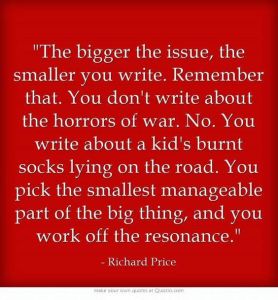
Writing Tip: Write Small

A quote: the bigger the issue, the smaller you write - Richard Price

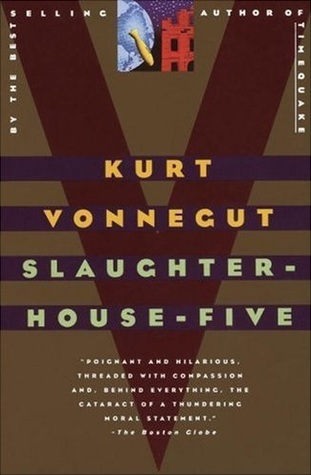
A fantastic example of this writing advice is Kurt Vonnegut’s  Slaughterhouse-Five.

Poignant and hilarious, threaded with compassion and, behind everything, the cataract of a thundering moral statement. – The Boston Globe

book cover of Kurt Vonnegut's 'Slaughterhouse-Five'

Kurt Vonnegut’s absurdist classic Slaughterhouse-Five introduces us to Billy Pilgrim, a man who becomes unstuck in time after he is abducted by aliens from the planet Tralfamadore. In a plot-scrambling display of virtuosity, we follow Pilgrim simultaneously through all phases of his life, concentrating on his (and Vonnegut’s) shattering experience as an American prisoner of war who witnesses the firebombing of Dresden.

Don’t let the ease of reading fool you – Vonnegut’s isn’t a conventional, or simple, novel. He writes, “There are almost no characters in this story, and almost no dramatic confrontations, because most of the people in it are so sick, and so much the listless playthings of enormous forces. One of the main effects of war, after all, is that people are discouraged from being characters.”

Slaughterhouse-Five is not only Vonnegut’s most powerful book, it is also as important as any written since 1945. Like Catch- 22, it fashions the author’s experiences in the Second World War into an eloquent and deeply funny plea against butchery in the service of authority. Slaughterhouse-Five boasts the same imagination, humanity, and gleeful appreciation of the absurd found in Vonnegut’s other works, but the book’s basis in rock-hard, tragic fact gives it a unique poignancy – and humor. – Goodreads

I highly recommend this book. A masterpiece.