So, here’s the thing: choose something in particular to write about. For example, what it felt like having a tennis lesson after a twenty year break. Give us the specifics. Dig deep for the details, but at the same time be aware of the world around you. As you focus on what you’re writing, at the same time stay conscious of your surroundings: the white painted cane Bentwood chairs in the café, the cool breeze from under the door on your sandaled feet, the hum of the traffic outside. Just add a sentence every now and then about the trees that overlooked the tennis courts while you were having a tennis lesson. When we focus on our writing it is good. Seeing the colour of the sky when you toss the ball gives breathing space to your story.
If you are sitting in Meditation you calm the butterfly mind by paying attention to your thoughts, giving them space by acknowledging them before returning to the breath, in and out through the nostrils. In the act of slowing down your breathing, as best you can, you remain open so that you are receptive to awareness of sounds as they arise: sounds near, sounds far, sounds in front, behind, to the side, above or below.
With every breath you take, you feel the air, the sound of the ball as it hits the racket, the players on the other courts.
We should always be living in the present, not by ignoring the world around us, but by paying close attention. It is not easy to stay alive to ‘what is’. When we slow things down in our writing, it is good practice.
What about you? Do you find a daily meditation practice assists your writing practice?
Have a read of my prose poem, “The Backpack”, first published in Quadrant Magazine. “The Backpack” is one of the stories in my collection, “Stories from Bondi” (Ginninderra Press). “Stories from Bondi”: the foibles of human nature, with all their pathos and humour, are laid bare for the reader.
The Backpack:
What can a man who meets you at the station and offers to carry your backpack mean to a woman traveling the world alone?
I was scared, like anyone who has no sense of direction. The journey was a series of stops and starts. Whether to use the Eurail pass or post it back home and ask the kids to get me a refund. Giovanni appeared one European winter, thick padded jacket, woolen beanie, scarf and gloves, tall and imposing, I’ll carry your bag.
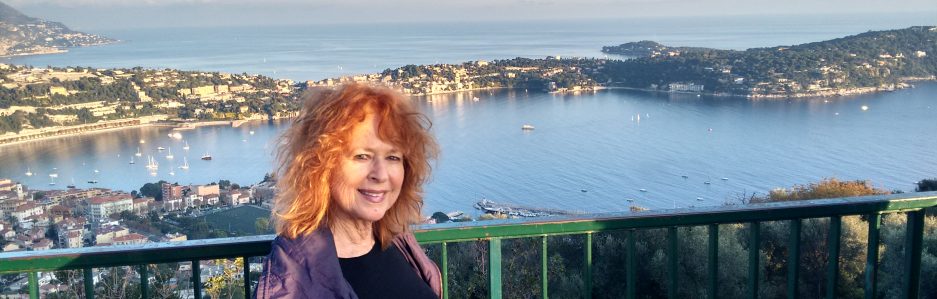
I was small, the backpack the length of my spine, the zip-off bag on one shoulder, the daypack positioned in front like a nine-month baby bump. That evening, as we climbed the steps of the Corniche – the wind bitter across the Mediterranean, the metal stairs covered with slippery ice, the railing melting beneath my hand. Soon it would become my railway platform, my steps, and Giovanni my landlord.
We walked there in the crisp night air. My own place. It didn’t cost much. No-one yet knew I was here. I could ask Giovanni if I needed any help. I knew my children would be pleased I had a base. I didn’t want them to worry. It was the thing I wanted the most secretly, studying maps, absorbing travel books. To be safe, a desire whispered to the moon that moved behind my shoulder at night. If you guide me to a safe haven I promise to be happy. And the moon listened. I did my best.
The winter sky closed down and the spring began its flowering. I took photos and painted and rang the children every week. Watch your money, don’t talk to strangers, be careful walking at night – you know the drill. The pebbly beach, the weekend markets, it was all there for the exploring. A glimpse of the sea between terracotta roofs – a vision in turquoise. The cobbled streets could show which way to follow – and none of them wrong. A room at the top of the stairs – till June I stayed reading the English books Giovanni had left in the bookcase, shopping for food, telling my kids and friends they should come for a visit.
Where had the months gone? Almost two years on the road. Summer approached. The rents would go up and the tourists arrive. Time to move on. I could only take with me what I could carry on my back. A Jewish gypsy they said. One more step into the unknown. Pack up, give away what I couldn’t manage, but keep the palette knife and miniature easel. There was stuff happening back home. The boys were grown and earning a living. Their sister turned twenty-one. People were reinventing themselves all over the place then coming back home. A thousand train rides later, my mother nearly eighty. I won’t be around much longer, she cried.
His was a helping hand in a world that says, but what are you doing there? What are you doing?
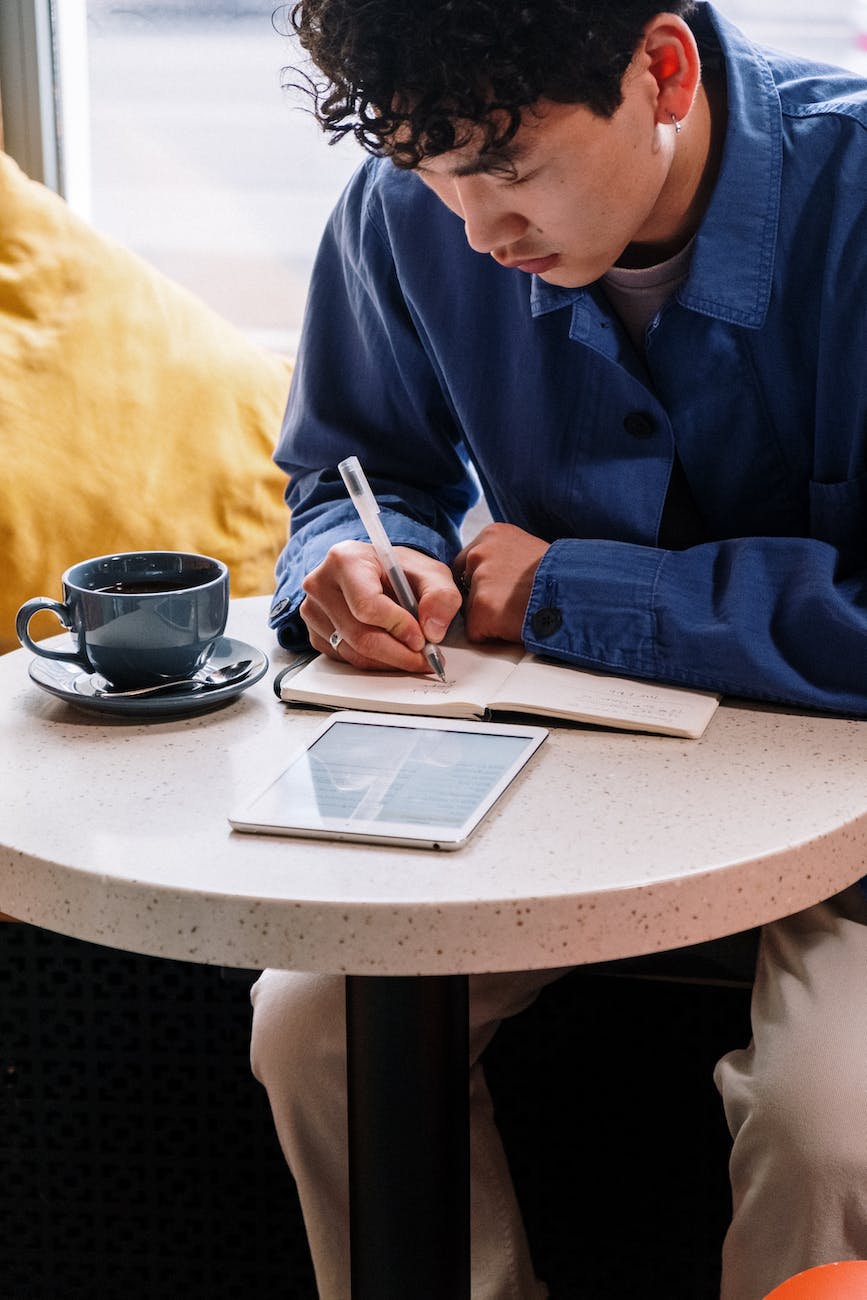
I am sitting in a café across the road from a Sydney beach. This stretch of road has a whole row of cafes side by side facing the sea. This is my favourite kind of writing place: one where I can sit comfortably for a long period of time and where the owners of the café know me and welcome me. This café is owned by a Brazilian man and his wife and has comfortable upholstered bench chairs with a direct view of the Pacific Ocean. For my two-hour writing session my choice could be a traditional Brazilian dish such as Coxinha, Feijoda or Moqueca. Or a cocktail like Caipirinha or Caipiroska. I must order something and it must be more that a Long Black, because I plan to be here for some time. I want the owners of the café to know I appreciate the time and the space they are allowing me.
However, today I’ll be very boring and order poached eggs on gluten-free bread
Why go to all this trouble to find a place to write? Why not just stay home and work? Because it’s good to get out and have a change of scene. I find I need to be happy and relaxed when I’m creating on the page and sitting in a café with a pleasant vibe works for me. Other writers need silence in order to concentrate, but I need to feel I am out and about in a beautiful place having a good time before the creative juices flow.
Strangely, working in a café can help to increase concentration. The busy café atmosphere keeps the sensory part of you occupied and content, so that the hidden, quieter part of you that composes and focuses is allowed to do its work. It is something like being cunning when trying to get a spoonful of food into a resistant toddler’s mouth . You pretend to be an aeroplane with all the sound effects and movements before landing the food-laden plane inside the child’s mouth. Mission accomplished.
What about you? Do you need to be at your desk in total silence in order to write, or do you like to experience the swell of humanity around you—to be surrounded by other human beings? Or at home listening to a particular kind of music?
Have a read of my short story ‘JM’ first published in Quadrant Magazine. ‘JM’ is part of my collection ‘Stories from Bondi‘ (Ginninderra Press) – the stories centre on women – their joys, doubts, loves and realisations. The foibles of human nature, with all their pathos and humour, …
JM:
I’ve never told anyone. To think about it makes my hands sweat and nausea rise from my stomach. It happened the year I turned eighteen on a sunny late afternoon in February, on the top floor of a building in Double Bay. I was recently engaged to be married and the wedding was booked for the end of June. We had gone to the photographer’s studio to have our engagement photos taken. The photographer was a good friend of my future brother-in-law. I had met him several times before and had thought of him as old, as my parents seemed to be old, but he can’t in those days have been more than fifty. He was tiny like a jockey, his trademark cravat tied at the neck beneath a tailored shirt. His accent, foreign but very English. His shirt covered the numbers branded on his arm – a childhood survivor of the holocaust.
I remember his navy and white cravat tied at the throat, but have to imagine his small white hands as he poured Vodka into liqueur glasses and the smile he must have worn on his face, encouraging me to watch the development process in the dark room after my fiancée went back to work.
Looking back at that afternoon I see myself as an ignorant half-adolescent, half-woman, shy, dreamy and vulnerable, in a rush to be grown up and living away from my parents. I longed for marriage to set me free.
I remember the way he held his fingers when he sipped from the Vodka, as if drinking from a delicate china cup. He had challenged me. Said, ‘You’re a woman now, aren’t you?’
I have lost touch with that person I used to be at eighteen, with what it felt like to be about to be married to a man who I loved more than he loved me.
It is almost spring. I am walking through the gulley of a park near where I live, from one end to the other. Walking is a form of relaxation, in which the legs take over. They go their own way. I watch the ground, all the way there and back, take stock of the sounds and smells, and the physical transformations, when I feel my shoulders return to their sockets as I wander along the path by the creek and through the trees.
During the period of our engagement I was being checked out by my future brother-in-law re my suitability to marry his wife’s brother. It was a reminder that I needed to show I could fit in to a European lifestyle: home-baked ghugelhoff and bishops bread, veal schnitzel, thinly sliced cucumbers soaked in vinegar and sugar, hot milk for the coffee served in a ceramic jug, Persian rugs on wooden floors.
I had emerged from dumpy adolescence into tiny-waisted, exciting womanhood. By spending whole afternoons in front of the bedroom mirror and catching my reflection in shop windows, and from the attention of some of the boys at the Saturday night dances, I discovered I had changed, from a large adolescent into a petit woman. I had brown curly hair like my aunt and my skin burnt and freckled in the sun before turning a honey-gold.
My father had seemed surprised that a mature man with his own successful business and good financial prospects began to visit our house. “Is he married already?’ he asked, his eyebrows in a scowl above his newspaper.
He was shocked, now that he saw me through a man’s eyes, at how far I had come from the young girl I was, my hair wound into curls like Shirley Temple by my mother’s home-perm kit, wearing frilly dresses he brought back from America from his business trips. If only my mother had been stricter with me, this older man wanting to marry me would never have happened. It was all my mother’s fault for letting me grow up too quickly, like letting me buy that strapless dress for the school dance. ‘You want to attract attention from boys,’ he accused me from across the breakfast table.
The fact is, I had exceeded, almost beyond my own expectations, in making myself look older. My mother must have wondered at times if I could ever be toned down with my body-hugging dresses, my geometric-cut hair with its dark rinse (wanting to look like Elizabeth Taylor), the black kohl pencil around the eyes, the eyeshadow, the stick-on false eyelashes, the thick foundation applied with a wet sponge. Not that this helped the outbreaks of pimples. I was out of their control and the pimples were out of my control. My mother was proud that I was getting married. When my father complained, she shook her head and dismissed him.
This is one of the places where I like to go, this park that is a creek valley with trees, shrubs and grasses growing on the sides of the basin and a watercourse where lizards and frogs laze. Twelve hectares of urban bush land not far from where I live.
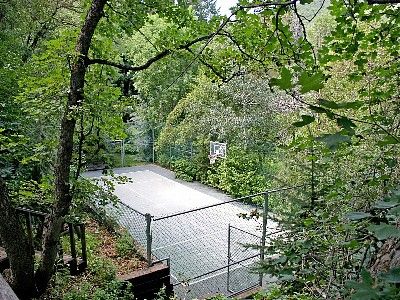
I enjoy walking along the winding network of paths, down through the bush vegetation that link a series of gazebos, bridges and staircases. On the sides of the lower valley, where the tennis courts are, rainforest plants of Blueberry Ash, Lillipilli and Black Wattle reflect the afternoon light.
I stop at a café near the courts, where lilac wisteria drapes the white painted wooden posts of the verandah. The branches of the wisteria are twisted around its own trunk. The sound of the punch of a tennis ball between two women on the court. In the café are cane high-backed chairs around small square tables. A group of white-clad tennis ladies stands up to leave. On the table are their water glasses beside screwed-up white paper serviettes and an empty water jug. When they leave, the glasses, the serviettes and the jug are the only sign that they have visited this place.
I am back in the photographic studio on that summer afternoon.
He unlocked the darkroom, rested his shoulder against the door and motioned me into the room. It was heavy with the smell of chemicals. I walked towards the tanks where the film lay and then moved around the edge of the baths. I was surrounded by darkness.
‘Ah,’ he said, sighing. ‘This is where it all happens.’
The room was appearing through the dark as my eyes became accustomed to the shadows. The black-clad windows, hanging trapped in the dark, kept out the outside streets, where people were doing their shopping or drinking short blacks at the sidewalk cafes or driving around looking for somewhere to park in the congested streets.
He pointed to one of the tanks and I moved over to look. ‘There,’ he said, ‘that’s the film in developing agent.’
He handed me my glass and moved around beside me. ‘What you can see is the first step of processing – can you see?’
I looked. It was remarkable. Later it was the pre-soaking, the dilution of the developer, submerging of the film, the timer, the push-cap on the tank, the ringing of the timer. The magic of developing photographs.
‘I still feel euphoric when working in the darkroom,’ he said.
Why didn’t I say something? His body rubbing against mine, his hands, his lips. What are you doing?
I watched. It was miraculous. The pre-soaking, the dilution of the developer, the submerging of the film, the click of the push-cap on the tank … and, then, the ringing of the timer. The stop bath, the Fixer, the film exposed to light, the wetting agent, submerging the reel. ‘You hang it up for drying for four to eight hours so it has enough time to dry and harden,’ he said.
I wasn’t used to alcohol, especially spirits. It immobilized me. My back pushed against a tank. I was overwhelmed, felt no power to control the moves. But I must have known what was going on.
He came very quickly.
My eyes were blurred with tears as I searched for my handbag in the reception area. I did not turn and face him, did not say anything, agreeing in my youthful ignorance, in a silence that was as good as a handshake, to carry the weight of this secret. With my high heels clicking on the concrete I walked unsteadily down the narrow passageway of the stairs that led out to the street and out into the daylight of the life that lay ahead.
The sound of water flowing over rocks in the creek hides lizards and tadpoles in the park. Smooth-barked Apple, Eucalyptus and Tick Bush on the sandy slopes. A blue-tongue lizard backs away as I pass, his chubby-splayed feet clutching at the path. Another lizard darts to safety, his body curling and curving into escape.
A small cement truck grinds down the cobbled pathway by the tennis courts. It tips cement into the mould for a wheelchair access ramp to the cafe. So many men to make a simple ramp – one carrying a wooden plank, one tapping at the wooden structure, two others in fluorescent vests who watch, instruct and chat. Their hair is spiked and hatless in the sun. Dark glasses wrap their browned faces.
‘I married you because you were suitable,’ my husband said. ‘I wasn’t wearing rose-coloured glasses.’
It all comes back.
All these years later, it is difficult to see the point in being back there, to be that ignorant, vulnerable eighteen-year-old girl I used to be.
The orange revolving light on top of the small concrete truck flashes. I look around at the tiny buds of spring that are framed by sticky spider webs. The webs don’t loosen their grip in the breeze.
The frangipani tree is devoid of foliage or flowers. But spring is on its way. The afternoon light on the tips of the green leaves on the terraced sides and layered rock shelves, barely move in the soft breeze.
Is this the end of one thing and the beginning of another? Will all that is familiar change into something else? Walking home I have no sense that anything has happened, that a shift may have taken place. Was it something in myself that has been waiting for so long and was finally brought to consciousness, that triggered something in me? Is it seeing the park poised to burst into spring, or watching the transformation of cement into a bridge connecting the cobbled path to the wooden verandah that make me realize that nothing is final or beyond change?


 Libby Sommer, Author