

Sounds, sights, and smells are all part of creating an atmosphere.
‘The creation of the physical world is as crucial to your story as action and dialogue. If your readers can be made to see the glove without fingers or the crumpled yellow tissue, the scene becomes vivid. Readers become present. Touch, sound, taste and smell make readers feel as if their own fingers are pressing the sticky windowsill.
‘If you don’t create evocative settings, your characters seem to have their conversations in vacuums or in some beige nowhere-in-particular. Some writers love description too much. They go on and on as if they were setting places at the table for an elaborate dinner that will begin later on. Beautiful language or detailed scenery does not generate momentum. Long descriptions can dissipate tension or seem self-indulgent. Don’t paint pictures. Paint action.’ – Jerome Stern, Making Shapely Fiction
Bringing in sensory detail is a way to enrich a story with texture to create the fullness of experience, to make the reader be there.
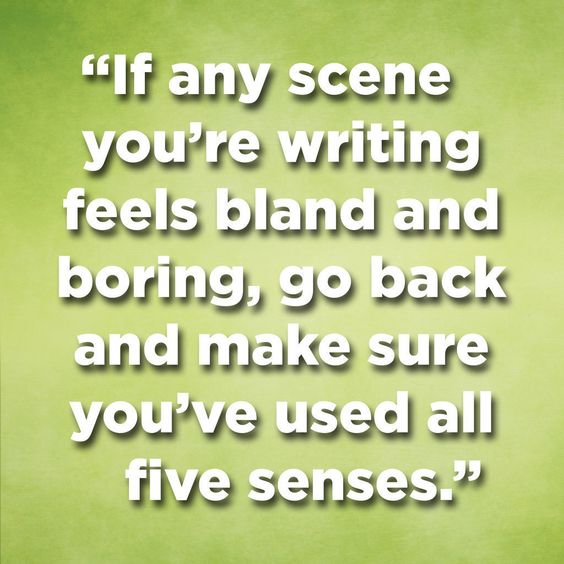
What about you? Do you use the senses, apart from sight, to create atmosphere?
 Libby Sommer, Author
I love description when done right. Like the quote says, sometimes writers just go on and on and on about descriptions that I wonder what it has to do with the story. Great tip, thanks for sharing!
LikeLiked by 2 people
thanks for your comment, Stuart. yes, description needs to be relevant and move the story forward in some way.
LikeLike
I am one of those who gets carried away with description, but more and more I rein myself in and do try to remember the senses. You’re right, they can be more effective and less wordy for sure :>)
LikeLiked by 2 people
yes, it’s good to find the unusual or quirky when writing a description i think, Lynne. the unique characteristics. i’m finding writing poetry is good for my cutting-back-to-the-essence-of-a-thing skills.
LikeLiked by 1 person
Good to meet you too calm Kate
LikeLike